
Blog
How to care for 101 Ecuadorian roses — a detailed guide
Mireya Florists · 27 July 2026 · 10 min read

A bouquet of 101 tall Ecuadorian roses is a serious investment — visual and emotional. To live up to expectations, it should last not five days, but ten to fourteen. The difference is in the details: trimming, water temperature, volume, the room it sits in. Everything else is myth.
This article is a practical guide from Mireya florists. Each block ends with a concrete action you can perform tonight, after receiving the bouquet.
Why Ecuadorian roses are different
Ecuadorian roses grow in the Andes at 2500–3000 m above sea level. The climate is stable year-round: 15–18 °C, steady humidity, strong UV. These conditions make growth slow — and slow growth produces thick 60–90 cm stems, large 6–8 cm buds, and dense velvet petals.
Unlike Kenyan or Ethiopian roses that open in 3–4 days and last 5–7 days in a vase, Ecuadorian roses go through a longer acclimatisation — the first 3–5 days they open gradually, and their full life with proper care is 7–14 days. In short: with good care they live nearly twice as long.
Takeaway: you are buying not just roses but a larger reserve of life. Your job is to not waste that reserve in the first 24 hours through preparation mistakes.
Trim stems every day — or not?
Yes, every day, but shallowly. About 1–2 cm from the end each day (or every other day if evenings are difficult).
Key rules:
- Diagonal cut at 45°. Increases the surface area of the xylem (water-conducting vessels). A straight cut blocks half of it.
- Sharp knife or garden secateurs — not scissors. Scissors crush the stem and block the xylem. Surgical precision is essential so the stem can drink freely.
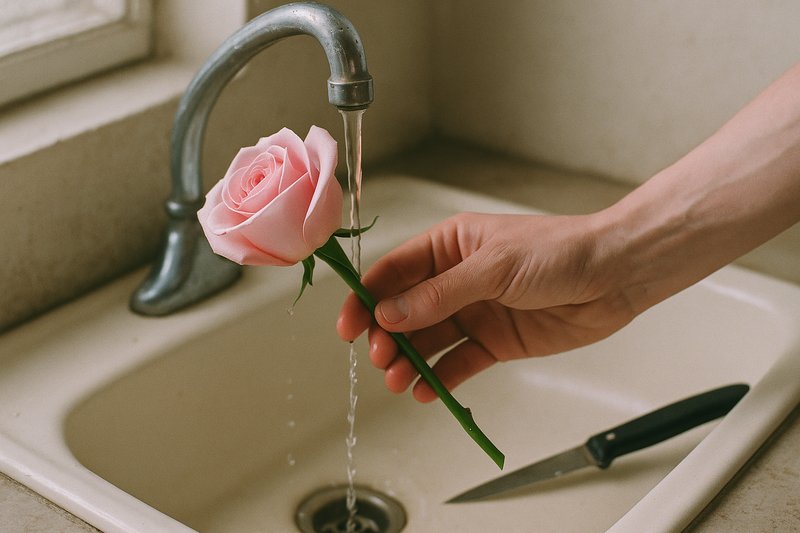
- Under water — optimal. When you cut in air, an air bubble enters the xylem (air embolism, an airlock) and the stem stops drinking instantly. A cut under running water eliminates this.
- First trim right after receipt. Even if the cuts look «fresh», the xylem dries out during transport. First trim — 2–3 cm; subsequent ones — 1–2 cm.
Practice: prepare a basin of cool water. Hold the stem under water and make a diagonal 45° cut with a sharp knife. Move the stem into the prepared vase immediately.
How often to change the water
For an ordinary bouquet — every 2 days. For a 101-stem bouquet — every day. The reason is mathematical: 101 stems release proportionally more sugars, flavonoids, and cellular debris, which speeds up bacterial growth many times over compared to a small 15-stem bouquet.
Signs the water needs changing:
- water has turned cloudy or yellow;
- an unpleasant smell has appeared;
- the vase walls feel slippery — that is a biofilm (biofilm) that holds bacteria and seeds fresh infections.
When changing water — wash the vase. Warm water + dishwashing liquid + soft sponge. Rinse, wipe the inside dry with a clean cloth. If you leave biofilm on the glass, bacteria will colonise fresh water within hours.
Water temperature
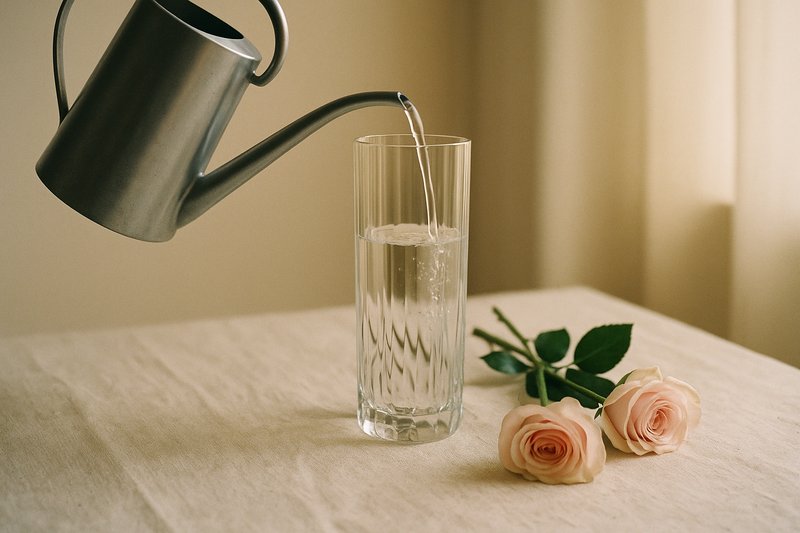
Optimal — 18–22 °C, room temperature.
- Cold water (below 10 °C) — bad. Thermal shock. The stem's stomata close and water uptake stops for several hours.
- Warm water (above 25 °C) — bad. Speeds up bud opening and shortens overall bouquet life.
- Boiled or filtered — better. No chlorine (tap water carries 0.5–1 mg/l, harmless to roses but sensitive varieties react). Softer water — less mineral scaling on stems.
Practice: pour water 30–60 minutes before the change, let it settle to room temperature. Then refill the vase.
Water volume
- Deep water: up to 2/3 of the stem length, roughly 15–20 cm deep in the vase. Ecuadorian stems are thick and drink a lot — a shallow 5–10 cm is not enough.
- Do not submerge leaves. Any leaf below the waterline becomes a bacterial hotspot. Before arranging, strip every leaf that will sit under water.
- Do not overfill. If water rises above 2/3, the petals of the lower roses will touch it and begin to rot. This is particularly critical for a dense 101-stem bouquet where the lower tier is packed.
Additives in the water
If you have a flower-food sachet with the bouquet, follow the exact dosage on the packet. The ratio is carefully balanced: sugar (nutrition), biocide (bacterial control), acidifier (lowers pH so the xylem conducts water more efficiently). Over-dosing the biocide damages stems — never double the sachet.
Home alternatives if the sachet is missing:
- Aspirin, ½ tablet per litre — acidifier.
- Sugar, 1 teaspoon per litre — nutrition.
- Bleach, 1–2 drops per litre — biocide. No more than that — it burns the xylem.
Do not add: vodka, coins, pure lemon juice. These popular tips have no scientific basis — at best they do nothing, at worst they harm.
Where to place the bouquet
The environment matters as much as the care itself.
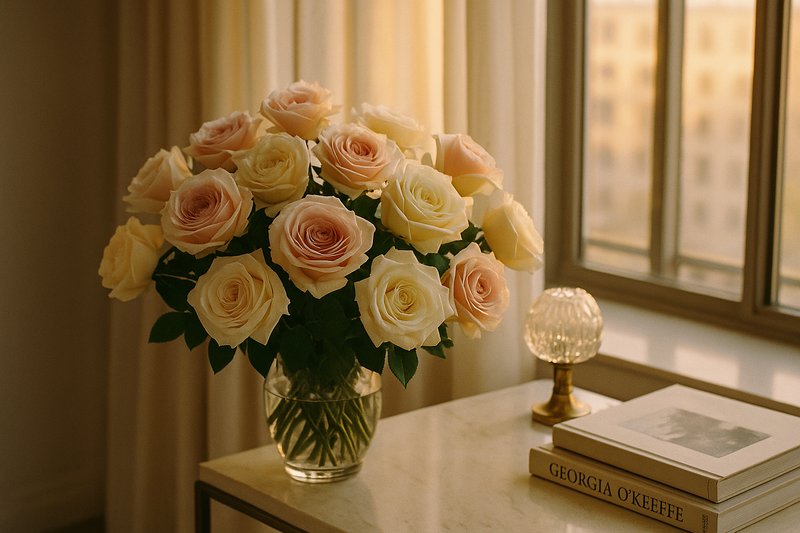
- Away from direct sunlight. Direct UV speeds up opening and evaporation through the petals. The bouquet can open in 1–2 days instead of 4–5.
- Away from drafts. A draft from a window or air-conditioner dries petal edges — they wilt first.
- Away from ripening fruit. Apples, bananas, peaches release ethylene (ethylene gas, a ripening hormone). Roses react instantly: flowers «ripen» and shed in 24–48 hours instead of a week. Never place the bouquet in a kitchen near a fruit bowl.
- Cool room at night. If you move the bouquet to a cooler room at night (bedroom, corridor, stair landing at ~15–18 °C), the roses will live 1–2 days longer.
- Away from radiators, fireplaces, cooktops. Dry hot air is the number-one enemy of bouquet life.
Removing leaves and thorns
- Remove all leaves below the waterline — mandatory. A submerged leaf decays in 24–48 hours and turns the water into a bacterial broth.
- Leaves above the waterline — keep them. They breathe, transpire, and take part in the stem's water balance. Strip them all and the stem will dry the bud faster.
- Thorns: those that fall below the water can be removed with a thorn stripper — they too seed bacterial colonies. Upper thorns are optional (aesthetics or protecting your hands). Do not scrape or grind — fresh wounds on the stem also invite infection.
Expected lifespan
- 7–14 days with proper care.
- Ecuadorian roses last 3–5 days longer than standard Kenyan or Ethiopian.
- Roses do not die at the same time. Usually 3–5 roses wilt first (normal, not an error), the other 90+ live the full term.
- Inspect the bouquet every day. Individual wilted flowers release ethylene and «infect» their neighbours. Remove them immediately — with the same sharp knife, cutting at the very base.
- A fully-open rose → 3–5 days of life. A rose still in bud → 8–12 days. A 101-stem bouquet always contains a mix of both phases — this is normal.
Peculiarities of a 101-stem bouquet
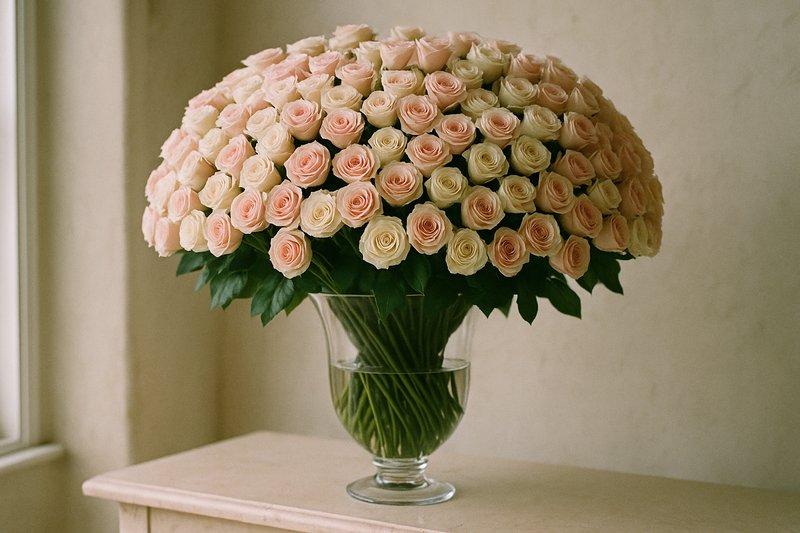
- Wide-neck vase — the stems should not press against one another. A classic narrow vase is unsuitable.
- Neck diameter: roughly 20–30 cm for 101 stems.
- Vase height: roughly 30–40 cm for 60–70 cm stems (lower 2/3 in water, upper 1/3 with buds — clear).
- Stability: a water-filled vase with 101 roses weighs 8–12 kg. Place it on a stable surface — a heavy table or stone worktop. A thin console table may not hold.
- Daily walk-around: a quick check around the perimeter, remove any wilted flowers.
- Change the water daily. To repeat — for 101 stems the standard «every-two-days» rule does not work.
Quick summary
If you read the whole thing and want the essentials — here is the short version:
- Trim 1–2 cm every day, at 45°, with a sharp knife, under water.
- Change the water every day, wash the vase with soap.
- Water at 18–22 °C, up to 2/3 of the stem length, no submerged leaves.
- Keep the bouquet away from sun, drafts, ripening fruit, and radiators.
- Every day remove any wilted flowers — they «infect» their neighbours.
A bouquet of 101 Ecuadorian roses deserves care worthy of the investment it represents. Follow these rules and it will last two weeks — with no extra effort, just consistency.
Share